

Chaplain David Long, commander at Wilson Sroufe VFW Post 9772, officiated the funeral of Army Cpl. Kenneth Ray Foreman on Dec. 2. Photo by Wade Linville
Funeral services held for Army Cpl. Kenneth ‘Ray’ Foreman

The funeral services for Army Cpl. Kenneth Ray Foreman were held Dec. 2 in Mt. Orab. Photo by Wade Linville

Danny Bolender is handed the flag of his late uncle, Army Cpl. Kenneth Ray Foreman, who died at the age of 19 on Dec. 2, 1950 while fighting for his country in the Korean War. Photo by Wade Linville
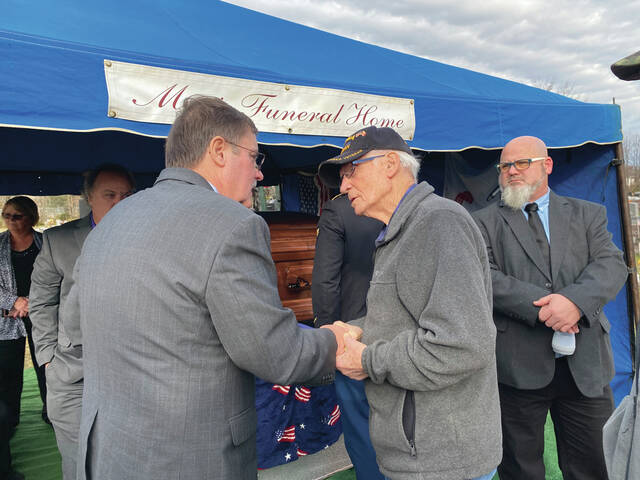
Korean War veteran, Roy Lawson, pays his respect to the family of the late Army Cpl. Kenneth Ray Foreman during the funeral services at Mt. Orab Cemetery on Dec. 2. Photo by Wade Linville
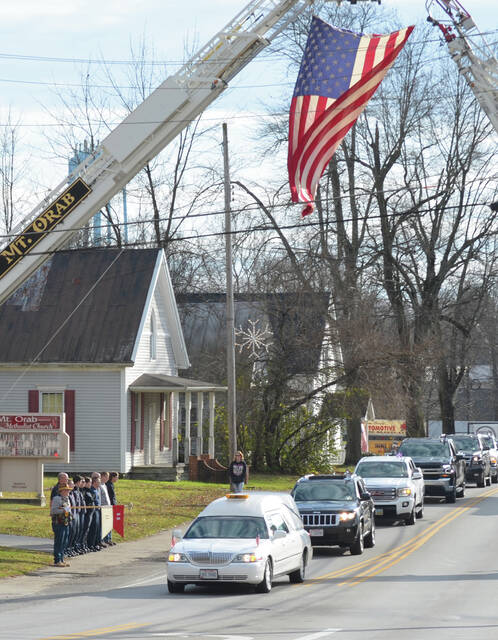
People lined the streets of Mt. Orab to show their respect for Army Cpl. Kenneth Ray Foreman and his family during the funeral procession on Dec. 2. Photo by Wade Linville
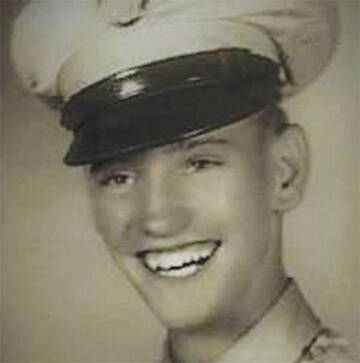
Army Cpl. Kenneth Ray Foreman
Danny Bolender said his family always had hope that his uncle, Army Cpl. Kenneth “Ray” Foreman, who had been missing since his service in the Korean War, would be found and returned home. Seventy-one years after he was declared dead, Cpl. Foreman’s family finally has closure.
Cpl. Foreman’s remains reached their final resting place in the Mt. Orab Cemetery on Dec. 2 after being identified by the Defense POW/MIA Accounting Agency on June 7 of this year. Surviving family members, local veterans, and even some old friends gathered at Crosspoint Wesleyan Church in Mt. Orab on the afternoon of Dec. 2 for the military funeral service of Cpl. Foreman with Chaplain David Long officiating.
People lined the streets of Mt. Orab from the church to Mt. Orab Cemetery, waving flags in honor of Cpl. Foreman as the hearse bearing his remains passed by. A large crowd then gathered at the cemetery where Cpl. Foreman was interred.
“It was wonderful. It’s more than I ever dreamed or expected it to be,” Danny Bolender, oldest living relative of Cpl. Foreman, said of the large turnout of those to pay respect to his late uncle. “I wish it would have happened during my grandparents’ and mother’s lifetime, they would have been so proud.”
After receiving letters early on that Cpl. Foreman was presumed dead, the older members of his family held on to hope for years that he was still alive. Danny Bolender said it was actually three or four years after he went MIA that his family received notice that he was pronounced dead.
“My dad was in World War II and he was a POW so they (my parents) went to a lot of seminars and conferences, and my mother went and gave DNA in 1997 and I took her again and gave DNA in like 2012,” said Danny Bolender. “Mom tried to instill that in me, to never forget and to never let go.”
Cpl. Foreman was only 19 years old when he died in the Korean War on Dec. 2, 1950 during the Battle of the Chosin Reservoir when his battalion was attacked by enemy forces.
Cpl. Foreman was awarded several medals for his service and sacrifice, which included: the Purple Heart, the Combat Infantryman’s Badge, the Korean Service Medal, the United Nations Service Medal, the National Defense Service Medal, the Korean Presidential Unit Citation and the Republic of Korea War Service Medal.
He was the son of the late James Howard and Thelma Pearl Foreman, born on March 29, 1931. He also had two sisters, JoAnne Bolender and Lennie Garrison, who are both deceased.
He is survived by nieces and nephews Danny L. (Monica) Bolender of Sardinia, Ohio, Terry Bolender of Mt. Orab, Ohio, Jamie Garrison of Dayton, Ohio, Sherry Garrison of Dayton, Ohio, and Michael Garrison on Dayton, Ohio; along with numerous great nieces and nephews.
Foreman was a member of Company A, 1st Battalion, 32nd Infantry Regiment, 7th Infantry Division.
On July 27, 2018, following the summit between President Donald Trump and North Korean Supreme Leader Kim Jong-un in June 2018, North Korea turned over 55 boxes, purported to contain the remains of American service members killed during the Korean War. The remains arrived at Joint Base Pearl Harbor-Hickam, Hawaii on Aug. 1, 2018, and were subsequently accessioned into the DPAA laboratory for identification.
To identify Foreman’s remains, scientists from DPAA used anthropological analysis, as well as circumstantial evidence. Additionally, scientists from the Armed Forces Medical Examiner System used mitochondrial DNA (mtDNA) and autosomal DNA (auSTR) analysis.
The Battle of the Chosin Reservoir took place about a month after the People’s Republic of China entered the conflict and sent the People’s Volunteer Army 9th Army to infiltrate the northeastern part of North Korea.
In November of 1950, the Chinese force surprised the US X Corps at the Chosin Reservoir. A 17-day battle in freezing weather soon followed, considered one of the most brutal in U.S. history. Through November and December of that year, 30,000 United Nations Command troops, later dubbed “The Chosin Few”, were encircled and attacked by around 120,000 Chinese troops. UN forces were able to break out of the encirclement and to make a fighting withdrawal to the port of Hungnam, inflicting heavy casualties on the Chinese. The retreat of the US Eighth Army from northwest Korea in the aftermath of the Battle of the Ch’ongch’on River and the evacuation of the X Corps marked the withdrawal of UN troops from North Korea.
Among those in attendance to pay their respect to Army Cpl. Kenneth Ray Foreman was Korean War veteran, Roy Lawson, who served in the vicinity of where Cpl. Foreman was killed during the Korean War.
“I’m glad he’s home,” said Lawson.
A soldier of Mt. Orab who stood up to fight for his country, a brave teenager who paid the ultimate sacrifice to protect its freedoms, Cpl. Foreman will be remembered as a true American hero.
“We’re here to say, ‘Welcome home, soldier,’” said Chaplain David Long.